
What is Tandem Skydiving?
You've been thinking about it. Maybe a friend asked you to come along for a jump. Or maybe you've had "jump out of a plane" on your bucket list for years. Either way, you're here because you want to know: what is tandem skydiving, and can you actually do it?
The short answer: absolutely. Tandem skydiving is the most popular and accessible way for first-time jumpers to experience the thrill of freefall. In fact, you don't need any prior experience — just you, a certified instructor, and an unforgettable ride from 14,500 feet.
This guide covers everything you need to know about your first tandem skydive. Specifically, you'll learn how it works, what it costs, and how to prepare for the tandem skydiving experience of a lifetime.
How Does a Tandem Skydive Work?
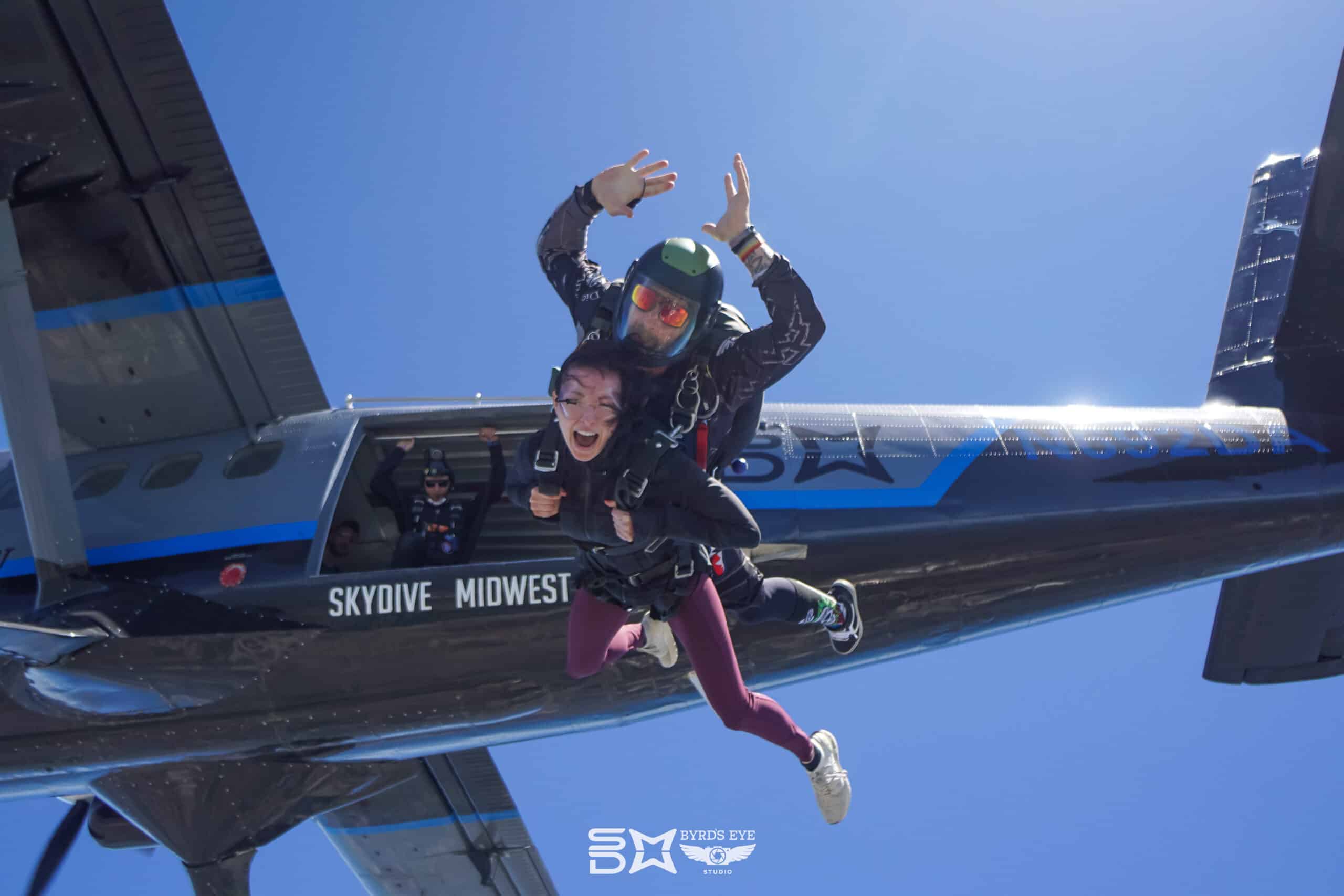
In a tandem skydive, a professional instructor securely attaches a first-time skydiver (the student) to their harness using a specially designed system. Together, the two exit the aircraft, freefall, and land — sharing a single parachute system for the entire experience.
The word "tandem" simply means "two in a line." For example, think of a tandem bicycle with two riders, one behind the other. Similarly, in a tandem skydive, the student stands in front of the instructor, both facing the same direction. The instructor wears the parachute on their back. The student then clips onto the front at four attachment points: two at the shoulders and two at the hips.
Because of this setup, the instructor handles all the critical tasks — deploying the parachute, steering, and managing the landing. So you get to focus entirely on the experience of human flight.
Configuration
All tandem skydives consist of an instructor and a student. The United States Parachute Association requires all tandem jumps be conducted with a certified instructor as the “pilot in command”. Unfortunately, this means your dreams of strapping yourself to your best friend and jumping together will have to be paused until one of you earns an instructor rating. (More on that later.)
The Set Up
The instructor wears the parachute container system on their back. It’s essentially a harness with a backpack containing 2 large parachutes. The student wears a harnessing system that attaches to the front of the instructor’s parachute system harness. There are 4 attachment points between the pair, two on the shoulders and two on the hips. The two are connected with the student in front of the instructor, facing away from them, like big spoon and little spoon.
Responsibilities
The instructor takes care of most of the duties on the skydive but the student has a few important jobs as well. Before the jump, each student receives instruction on exiting the aircraft, proper body position during freefall and landing procedures.
Here's what a typical tandem skydive looks like from start to finish at Skydive Midwest:
1. Check-In and Paperwork
When you arrive at the dropzone, you'll check in, complete a waiver, and get sized for your harness. Overall, this takes about 15–20 minutes.
2. Ground Training
Next, your tandem instructor will walk you through a brief ground school session. You'll learn the body position for exiting the plane: arched back, head up, hips forward. Your instructor also covers hand position during freefall and how to lift your legs for landing. This training typically lasts 15–30 minutes. In other words, that's all the training you need — your instructor handles everything else.
3. Gear Up
Your instructor will then help you into your student harness. It fits over your clothes and has adjustable straps at the chest, legs, and shoulders. Once you're suited up, your instructor does a thorough equipment check and clips you onto the front of their harness.
4. The Plane Ride to Altitude
You'll board the aircraft and ride up to jump altitude — 14,500 feet at Skydive Midwest. The ride takes about 15–20 minutes in our multi-engine aircraft. Meanwhile, the views on the way up are spectacular. You'll see the rolling Wisconsin countryside, Lake Michigan on the horizon, and on clear days, the Chicago skyline.
5. Freefall!
This is the moment. Your instructor positions you at the open door, you arch your body, and out you go. Freefall lasts approximately 60 seconds from 14,500 feet. You'll reach speeds around 120 miles per hour. But it doesn't feel like falling — it feels like flying on a giant column of air. The rush of wind, the panoramic views, the pure adrenaline — it's the most exhilarating 60 seconds of your life.
6. Parachute Deployment and Canopy Ride
Then at around 5,500 feet, your instructor deploys the tandem parachute. The transition from freefall to canopy flight is smooth and gradual. Once the parachute opens, everything gets peaceful and quiet. The canopy ride lasts 5–7 minutes. Your instructor may even let you steer the parachute and take in the views. In fact, many jumpers say this is their favorite part.
7. Landing
Finally, your instructor guides the parachute to the landing area. For landing, you lift your legs up and slide in on your backside. It's easier and safer than a stand-up landing. Then you're back on solid ground, probably grinning from ear to ear.
What Equipment is Used for Tandem Skydiving?
Tandem skydiving uses specialized equipment designed for two-person jumps. Here's what's involved:
- Tandem parachute container system: The instructor wears a large backpack-style system that holds the main canopy and a reserve canopy. Tandem canopies are significantly larger than solo parachutes because they need to support the combined weight of two people.
- Student harness: You wear a separate harness that clips onto the front of the instructor's container at four secure attachment points.
- AAD (Automatic Activation Device): This electronic safety device automatically deploys the reserve parachute if the skydivers reach a certain altitude without the main canopy deployed. It activates regardless of human input.
- Altimeter: The instructor uses this to track altitude throughout the jump.
- Goggles: These protect your eyes from wind during freefall at 120 mph.
At Skydive Midwest, we inspect all tandem equipment before every jump and maintain it to strict FAA and USPA standards. Also, wondering what to wear? Check out our guide on what to wear skydiving — shorts or pants, sneakers, and a t-shirt work great.
Who is Your Tandem Instructor?
Your tandem instructor isn't just someone who likes skydiving. In fact, they're one of the most trained and experienced people at the dropzone. Specifically, to earn a tandem instructor rating, a skydiver must:
- Hold a D-License (the highest USPA skydiving license)
- Have a minimum of 500 completed skydives
- Have at least 3 years of active skydiving experience
- Obtain an FAA Class 3 Medical Certificate
- Complete 50 jumps within the past 12 months (staying "current")
- Pass a USPA Tandem Instructor Rating Course
At Skydive Midwest, our tandem instructors have thousands of jumps each. Many have been jumping for 10–20+ years. So when you're strapped to your instructor, you're in the hands of a true professional.
Is Tandem Skydiving Safe?
Safety is the number one question every first-time jumper asks, and it's a great question. Here's the reality:
In fact, tandem skydiving has an excellent safety record. According to the United States Parachute Association (USPA), millions of people make tandem jumps each year in the United States. The sport follows rigorous equipment standards, instructor certification requirements, and operational procedures — all designed to minimize risk.
For example, every tandem parachute system carries two canopies — a main and a reserve. On top of that, every system includes an Automatic Activation Device (AAD). The AAD deploys the reserve parachute automatically if needed — completely independent of the instructor. So even in a worst-case scenario, multiple safety systems work together to bring you safely to the ground.
Is there risk? Yes — skydiving is an extreme sport and no activity is completely risk-free. But tandem skydiving is the safest form of the sport. At a USPA member dropzone like Skydive Midwest, you can trust that safety always comes first. Want the full breakdown? Read our article on skydiving safety.
Can You Jump Solo Your First Time?
This is one of the most common questions we get. In short, the answer is no — you cannot skydive completely solo on your very first jump. Every beginning skydiver starts with either a tandem jump or a supervised solo program, but never unsupervised solo.
With a tandem skydive, you stay connected to your instructor the entire time. It's the lowest-barrier entry point into skydiving and by far the most popular choice for first-timers.
However, if you're interested in eventually skydiving solo, tandem is actually the best first step. At Skydive Midwest, we offer programs where you can start building solo skills from day one. Check out our learn to skydive page to see how to go from your first jump to a licensed skydiver.
Who Can Make a Tandem Skydive?
In fact, one of the best things about tandem skydiving is how accessible it is. The basic requirements are:
- Age: You must be at least 18 years old. There are no exceptions, even with parental consent. Read more about age requirements for skydiving.
- Weight: At Skydive Midwest, the weight limit is 250 pounds. Most dropzones charge extra fees — sometimes $1 per pound over a threshold. We don't. Every student jumps with the same equipment regardless of size. Read our full tandem skydiving weight limit page for details.
- Health: You should be in reasonable health. If you have heart conditions, recent surgeries, or other serious medical issues, check with your doctor first. You don't need to be an athlete — people of all fitness levels make tandem jumps every day.
- No experience needed: That's the whole point. Your instructor handles the technical aspects, so complete beginners are welcome.
Can My Friends Tandem Skydive with Me?
Absolutely! Bringing friends is one of the best parts. Here's how it works:
- You and your friends can all ride up in the same plane — we fly a multi-engine aircraft that fits 23 jumpers per load.
- Each person gets attached to their own certified tandem instructor.
- You'll exit the plane one pair at a time (not simultaneously), with a short delay between each pair for safety.
- If you jump first, you'll be on the ground in time to watch your friends land!
Pairs exit one at a time with spacing between each — standard safety practice at every dropzone.
Group jumps are incredibly fun. What's more, we offer group discounts starting at just 3 people:
| Group Size | Price Per Person | Organizer Price |
|---|---|---|
| 3–5 jumpers | $229 | — |
| 6–10 jumpers | $219 | $199 |
| 11+ jumpers | $209 | $189 |
How Much Does a Tandem Skydive Cost?
At Skydive Midwest, a tandem skydive from 14,500 feet starts at $229 on weekdays and $259 on weekends with a reservation. Walk-ins are $299.
Most first-time jumpers also add a video package to capture the experience:
- Hand Cam — $99 (video from the camera mounted on your instructor's hand — their perspective of your entire jump)
- Premium — $136.50 — A separate videographer jumps with your tandem pair and films from the outside. Photos and video included. This is our most popular option.
- Extreme — $189 (the best of both — hand cam footage plus the outside videographer, so you get every angle)
Every package comes fully edited. Specifically, you get three versions: a short clip for social media, a highlight reel, and the full edit. The full edit covers everything from your ground interview to landing. Same-day delivery too, so you'll have footage to share before you even leave the dropzone.
For current deals and seasonal offers, also check our pricing page or view available deals.
When is the Best Time to Make a Tandem Jump?
Skydiving is a warm-weather sport in the Midwest. At Skydive Midwest, our season runs from April through October, with peak conditions from May through September. In particular, morning jumps tend to have the calmest winds and clearest skies.
Why Choose Skydive Midwest for Your Tandem Skydive?
Skydive Midwest sits right off I-94 in Sturtevant, Wisconsin. We're just minutes from Milwaukee and about an hour from Chicago. Since 2004, we've been putting first-time jumpers in freefall. Here's why thousands of skydivers choose us:
- 14,500-foot altitude: We jump from 14,500 feet — higher than most dropzones in the Midwest. As a result, you get a full 60 seconds of freefall.
- Multi-engine aircraft: Our plane carries 23 jumpers per load, which means less waiting and more jumping.
- Experienced team: Our tandem instructors have thousands of jumps each and have been safely taking students on tandem skydives for years.
- No weight surcharge: We don't charge extra fees based on your weight — everyone pays the same price up to our 250-pound limit.
- Same equipment for every student: Every tandem student jumps with the same canopy, container, reserve, and AAD — no downgrades based on size.
- Incredible views: Jump over the Wisconsin countryside with views of Lake Michigan and the Chicago skyline on clear days.
- Easy access: Right off I-94 — convenient for jumpers from Chicago, Milwaukee, Racine, Kenosha, and all of southern Wisconsin.
- Thousands of 5-star reviews from first-time jumpers who had the ride of their lives.
Ready to Make Your First Tandem Skydive?
Now you know what tandem skydiving is, how it works, and what to expect. The only thing left is to experience it for yourself.
Tandem skydives start at $229. Book your jump or call us at (262) 886-3480 to reserve your spot. Walk-ins are welcome during the season, but reservations are recommended — especially on weekends.
A tandem skydive is a skydiving experience where a first-time jumper is securely harnessed to a certified instructor. The two jump together, freefall together, and land together using a single parachute system. It's the safest and most popular way for beginners to experience skydiving — no prior experience or training is required.