
Tandem Skydiving Weight Limit
Is There a Weight Limit for Skydiving?
Yes. All drop zones must implement a tandem skydiving weight limit to stay within the tested parameters of the equipment. There's no single skydiving weight limit that applies industry-wide — every drop zone sets its own number — but there's almost always a weight limit for parachute jump operations in place, and at Skydive Midwest, ours is 250 lbs.
Is There a Minimum Weight Limit for Skydiving?
There is no set minimum weight limit. However, tandem harness fit is critical. If a person's body type, shape, or size prevents us from achieving a proper harness fit, they won't be able to make a skydive — regardless of weight.
What is the Weight Limit for Skydiving?
At Skydive Midwest, the weight limit for tandem customers is 250 lbs. However, each skydiving center can determine their own weight limit to a certain extent. Usually 230-260 lbs.
Most drop zones in the Midwest set their limit between 200 and 260 lbs. The difference? Some set a lower "limit" — like 200 lbs — and then charge you extra for every pound over. Others, like us, set a firm limit at 250 lbs and charge you the same price whether you weigh 120 lbs or 249 lbs.
Is There a Parachute Weight Limit?
Yes. Every parachute system has a parachute weight limit — and it's not a guideline, it's an engineering spec. For tandem skydiving, the parachute weight limit is built into the rig itself: most tandem systems max out at 500 lbs of suspended weight, which covers the student, the instructor, and all the gear combined. Subtract the instructor and the gear, and you're left with the number drop zones publish as their student weight limit.
When people ask "is there a skydiving weight limit?" they're usually asking two questions: is there one across the industry, and is there one here? The answer to both is yes. Every legitimate drop zone has a posted weight limit because the equipment manufacturers require it. What varies is *the number* and how the drop zone handles jumpers close to the line.
If a drop zone tells you there's no parachute weight limit, that's a red flag. Either they're not using TSO-certified equipment, or they're willing to bend rules they shouldn't bend. Neither is what you want at 14,500 feet.
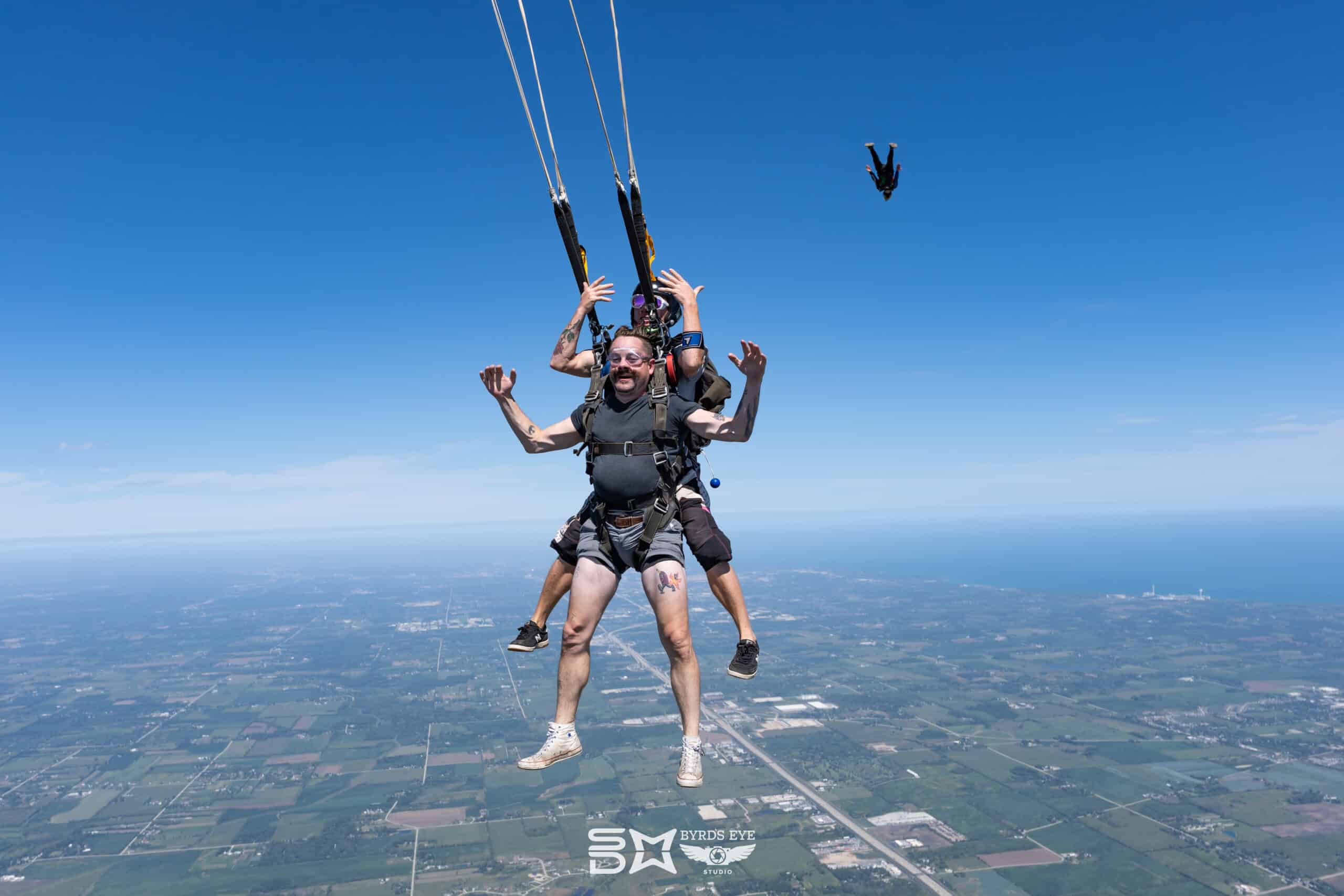
Why is there a weight limit for skydiving?
The TSO (Technical Standard Orders) of the parachute system determines the maximum weight limit for a tandem skydive. The same TSO sets the parachute weight limit you'll find at every certified drop zone — it's an industry-wide engineering standard, not something each operator makes up.
For most tandem rigs, that limit caps at 500 lbs of suspended weight. The total includes the tandem student, the tandem instructor, and the gear itself.
Skydiving equipment is extremely durable and well-made. The harness alone can withstand thousands of pounds of force. However, safety is our number one priority and we always abide by manufacturer specifications, federal regulations, and United States Parachute Association (USPA) requirements.
Here's how the math works: if the equipment maxes out at 500 lbs of suspended weight and the gear itself weighs roughly 60 lbs, that leaves about 440 lbs for the instructor and student combined. Most tandem instructors weigh between 160-200 lbs, which is where the 230-250 lb student limit comes from. It's not an arbitrary number — it's based on engineering.
What is the Average Skydiving Weight Limit?
If you're shopping around and comparing drop zones, the number a drop zone advertises doesn't always tell the full story.
Some drop zones advertise a 250 lb limit and mean it — that's the actual cutoff, and everyone under that weight pays the same price. That's what we do at Skydive Midwest.
Other drop zones advertise a 250 or 260 lb limit, but the real story is buried in the fine print. Their actual limit before surcharges kick in might be 200 lbs. Everything above 200 gets charged extra, sometimes in tiers that add $25, $50, or even $100 to your bill.
And then there are the places that not only charge more, but also give you a worse experience. We've seen drop zones that charge jumpers over 200 lbs an extra $50-$100 AND reduce their jump altitude at the same time. You pay more and get less freefall. That's a rough deal.
When you're comparing weight limits, don't just look at the maximum number. Ask what happens between their surcharge threshold and their actual limit. That's where the hidden fees live.
Will I be weighed before skydiving?
Yes. Each customer must step on a scale during the check-in process to confirm their weight. If you're self-conscious about your weight, don't worry. The display is behind the counter and only our customer service representative will see your weight.
We get it — stepping on a scale in front of people isn't anyone's idea of a good time. But it's a safety requirement, not a judgment. We need an accurate weight to pair you with the right instructor and configure the equipment correctly. It takes about two seconds, nobody else sees it, and then you're on to the fun part.
Will I be charged extra based on weight?
Skydive Midwest does NOT charge a surcharge based on weight. However, many skydiving centers set a lower weight limit and charge what the industry calls a "fat tax" for each pound or increment over the "limit."
Here's a real example from a competitor's pricing:
- Jumpers weighing 200lbs - 220lbs will be charged a $25.00 surcharge
- Jumpers weighing 221lbs - 240lbs will be charged a $35.00 surcharge
- Jumpers weighing 240lbs - 250lbs will be charged a $45.00 surcharge
Weight Restrictions for Skydiving, What to Expect.
Weight restrictions for skydiving exist for one reason: tandem parachute systems are engineered for a specific load range, and operating outside that range is a safety problem. So when a drop zone publishes a weight limit to skydive, treat it as a hard line — not a target to negotiate around.
Where drop zones differ is how they handle weight restrictions for skydiving. Some publish a clean number with no fine print (us). Some post a high limit but bury surcharges in the booking flow. Some won't tell you the actual weight limit to skydive until you arrive and step on the scale. Ask before you book. Any honest drop zone will give you a straight answer over the phone.
At Skydive Midwest, the rules are simple: 250 lbs dressed, no surcharges, full 14,500 ft altitude. Whether you weigh 130 or 240, your jump and your price are the same.
Do All Skydiving Centers Charge Weight Surcharges?
No. But a lot of them do.
We looked at the major drop zones in the Midwest, and the weight surcharge policies vary:
- Some set their surcharge threshold at 200 lbs and charge tiered fees — $25 for 200-220 lbs, $35 for 221-240 lbs, and $45 for 241-250 lbs. If you're on the heavier side, that can add up to nearly $300 for a single tandem jump.
- Others go even further — charging $50-$100 in surcharges AND reducing your jump altitude. So you're paying more money for less freefall time.
- A few don't even publish their surcharge amounts. You find out what you owe when you show up. Surprise fees on an activity that already costs a couple hundred bucks? Not great.
At Skydive Midwest, we keep it simple. 250 lb limit. No surcharge. Full 14,500 ft altitude for every jumper. Your price is your price — $229 weekday, $259 weekend. If you're looking for a drop zone in the Chicago, Milwaukee, or southern Wisconsin area that doesn't hit you with extra fees based on weight, that's us.
Why do some skydiving operations charge based on weight?
There are several arguments for a fee based on weight; work load, safety, wear and tear on equipment and increased fuel consumption. While some of these arguments have validity, we find that most of them are just an excuse to get more money from customers.
Instructor Work Load
Additional weight can create more work for instructors. This rationale, we agree with. More weight does equal more work sometimes. However, punishing a customer based on their weight and hitting them with additional, "hidden" fees on an already expensive activity seems like bad business to us. Some jumps are harder, some jumps are easier and hopefully it balances out at the end of the day.
If you want to reward your instructor for their efforts, consider leaving gratuity. For information on if/when you should tip and how much, check out our blog; Tipping in Skydiving
Safety
Some skydiving centers claim parachute performance and safety become an issue at higher weights. Our argument is simple: charging someone an extra $45 does not make the skydive any safer. Either a skydive can be conducted safely or it can't — a fee changes nothing about the actual safety of the jump.
Wear and Tear on Equipment & Fuel Consumption
Claims of additional wear and tear on equipment and increased fuel burn as a result of weight are negligible. Charging based on weight is more of a "money grab" and shady sales tactic than anything else.
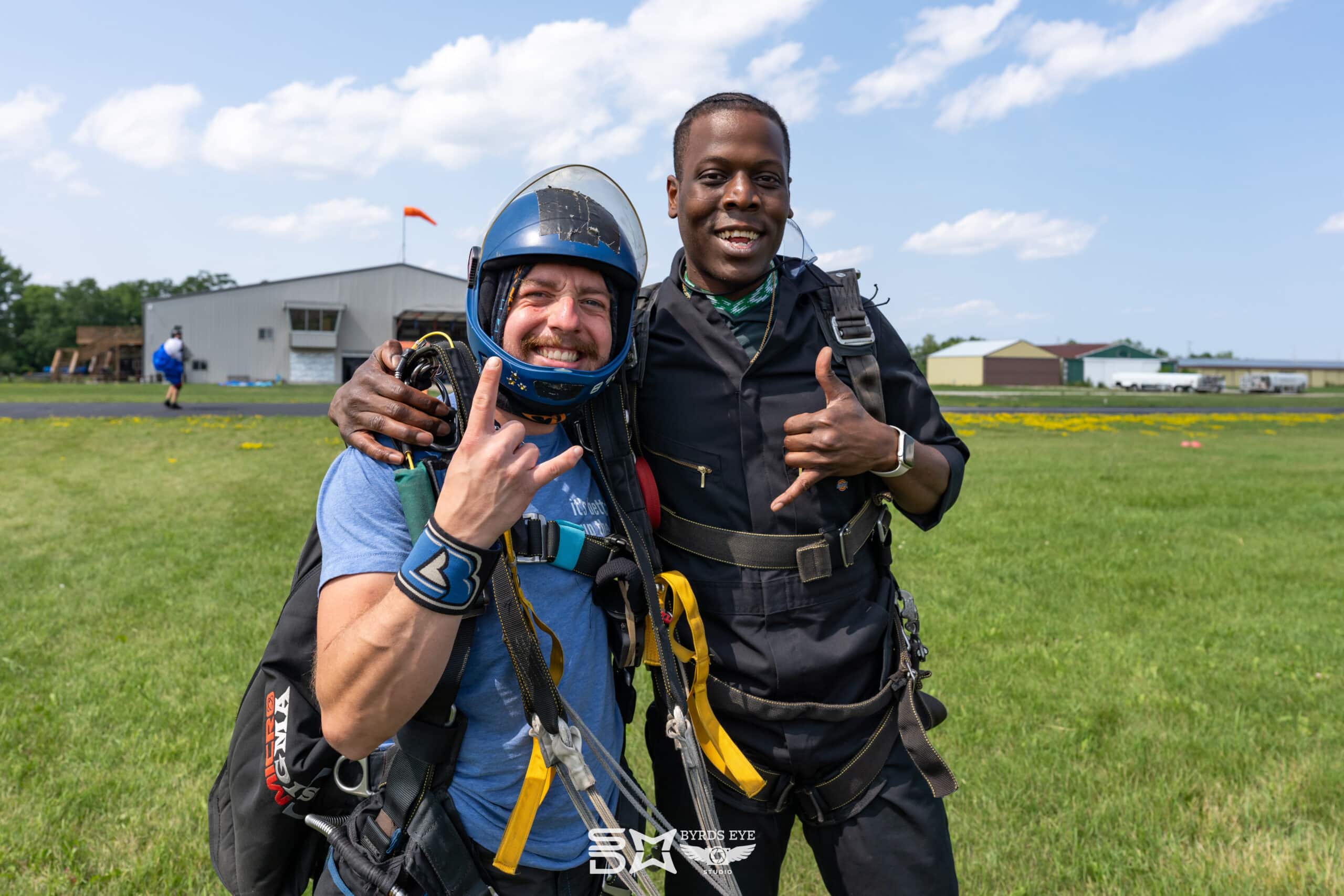
What Happens if I'm Over the Weight Limit?
If you weigh more than 250 lbs, we won't be able to take you on a tandem jump. It's a hard limit — not because we don't want to, but because we can't do it safely within the manufacturer's specifications.
We don't bend this rule. Some drop zones will look the other way and take jumpers over their posted limit, which is a safety problem we want no part of. If we say 250, we mean 250.
If you're close to the limit, a few tips:
- Weigh yourself at home first. Step on a scale in what you'd wear to the drop zone — clothes, shoes, the whole deal. Our scale measures dressed weight, not body weight.
- Clothing matters. Heavy boots, jackets, belt buckles — it all adds up. Wear lightweight, comfortable clothing and you might save yourself a couple of pounds.
- Call us. If you're right on the line, give us a call at (262) 886-3480 before booking. We'll give you a straight answer. No judgment, no runaround.
If you're over 250 lbs right now but working on it — book for later in the season. We're open April through October and there's plenty of time.
Does Weight Affect the Skydiving Experience?
Yes. Heavier jumpers fall faster in freefall — that's physics. All of our tandem equipment uses the same canopy, container, reserve, and AAD regardless of student weight, so a heavier jumper puts more wing loading on the parachute. That means a faster canopy ride and a shorter time under canopy.
You're still jumping from 14,500 ft, still getting freefall, and still floating under a parachute with views of Lake Michigan and the Chicago and Milwaukee skylines. Your instructor has done this thousands of times and knows how to manage the jump at any weight within our limit
The bigger difference is what happens at other drop zones. Some reduce your jump altitude if you're over a certain weight, which means less freefall time. At Skydive Midwest, every tandem customer jumps from the full 14,500 ft regardless of weight. Same altitude, same equipment, same price.
Can I Still Skydive If I'm Close to the Weight Limit?
If you weigh 240-250 lbs, yes. You're within our limit and you'll have the same experience as every other tandem customer. We don't start treating you differently at 200 lbs. As long as you're at or under 250 lbs dressed, you're good to go. The only other requirements are that you're at least 18 years old with a valid ID and in reasonably good health.
For the best tandem skydiving experience in the Midwest with no hidden fees, no surprise weight restrictions for skydiving customers, and no shady sales tactics, BOOK NOW!
Frequently Asked Questions
What is the weight limit for tandem skydiving?
Most drop zones set their tandem weight limit between 200 and 260 lbs. At Skydive Midwest, the limit is 250 lbs. This is based on the manufacturer's maximum suspended weight rating for the equipment (500 lbs total for student, instructor, and gear combined).
Is there a weight limit for parachute jumping?
Yes. All tandem parachute jumps have a weight limit determined by the TSO (Technical Standard Orders) of the equipment. The specific limit varies by drop zone, but most fall between 230-260 lbs for the student. Skydive Midwest's limit is 250 lbs.
Do skydiving centers charge extra for heavier jumpers?
Many do. Weight surcharges of $25-$100 are common at drop zones that set their "limit" at 200 lbs and charge tiered fees above that. Some also reduce jump altitude for heavier jumpers. Skydive Midwest does not charge any weight surcharges and jumps from the full 14,500 ft altitude for all customers.
Can you go skydiving if you're overweight?
If you're under the drop zone's weight limit, yes. At Skydive Midwest, anyone at or under 250 lbs can make a tandem skydive. There are no extra fees and no reduced experience based on weight. You'll jump from 14,500 ft just like everyone else.
What happens if I weigh more than the skydiving weight limit?
If you're over 250 lbs, we cannot take you on a tandem skydive. This is a safety requirement based on equipment specifications, not a preference. We recommend calling ahead at (262) 886-3480 if you're close to the limit so we can answer any questions before you book.
Will I be weighed at the drop zone?
Yes. All tandem customers are weighed during check-in. At Skydive Midwest, the scale display faces away from other customers and only our staff can see it. It's quick, private, and a standard part of the safety process.
Why do some drop zones charge a weight surcharge?
Drop zones typically justify weight surcharges by citing increased instructor workload, equipment wear, and fuel costs. While some of these have a kernel of truth, the actual added costs are minimal. Most weight surcharges are a revenue tactic, not a safety measure. Charging someone $45 extra does not make the skydive any safer.
Does weight affect skydiving safety?
Within the equipment's rated limits, weight does not meaningfully affect safety. All tandem gear is TSO-rated to 500 lbs of suspended weight. As long as the combined weight of the student, instructor, and equipment stays under that threshold, the skydive can be conducted safely. That's why we have a weight limit — if you're under it, you're within the safe operating range.
What are the weight restrictions for skydiving
Weight restrictions for skydiving are set by the manufacturer's TSO rating on the tandem parachute system, which caps total suspended weight at 500 lbs (student + instructor + gear). Drop zones translate that into a student weight limit — usually 230 to 260 lbs. At Skydive Midwest, the limit is 250 lbs and there are no weight surcharges.