
Is Skydiving Safe? Here's What the Numbers Actually Say
Is skydiving safe? In 2024, there were 9 fatalities out of 3.88 million skydives at USPA-member dropzones — the lowest rate on record (0.23 per 100,000 jumps). Tandem skydiving, designed for first-timers, averages roughly 1 fatality per 500,000 jumps. Like any extreme sport, skydiving carries inherent risk, but the safety record has improved dramatically over six decades.
Is skydiving safe? It's the first question almost everyone asks — and it deserves a straight answer.
If you're nervous, that's normal. Almost every first-timer we've taken up has felt the same way. Here's what we tell everyone who asks.
Skydiving is an extreme sport. It carries inherent risk, including the risk of serious injury or death. We won't sugarcoat that — you deserve to know what you're getting into.
But the numbers tell a story that surprises most people. In 2024, skydiving recorded the lowest fatality rate since record-keeping began in 1961. The sport's safety record has never been stronger.
Let's break down the data so you can make an informed decision.
Last updated: March 2026
Skydiving Safety Statistics: The Real Numbers
The United States Parachute Association (USPA) has tracked every skydiving fatality in the country since 1961. Here's where things stand:
2024 USPA Data:
- 3.88 million skydives made at USPA-member dropzones
- 9 fatalities — the first single-digit year on record
- Fatality rate: 0.23 per 100,000 jumps (1 in 434,783)
To put that in perspective — you're more likely to be struck by lightning this year than to die on a skydive.
For context, back in the 1970s, there were an average of 42 skydiving fatalities per year — with far fewer people jumping. Today, nearly 4 million jumps happen annually and the number keeps dropping. That's decades of better training, better equipment, and a safety culture that doesn't cut corners.
How Safe Is Tandem Skydiving?
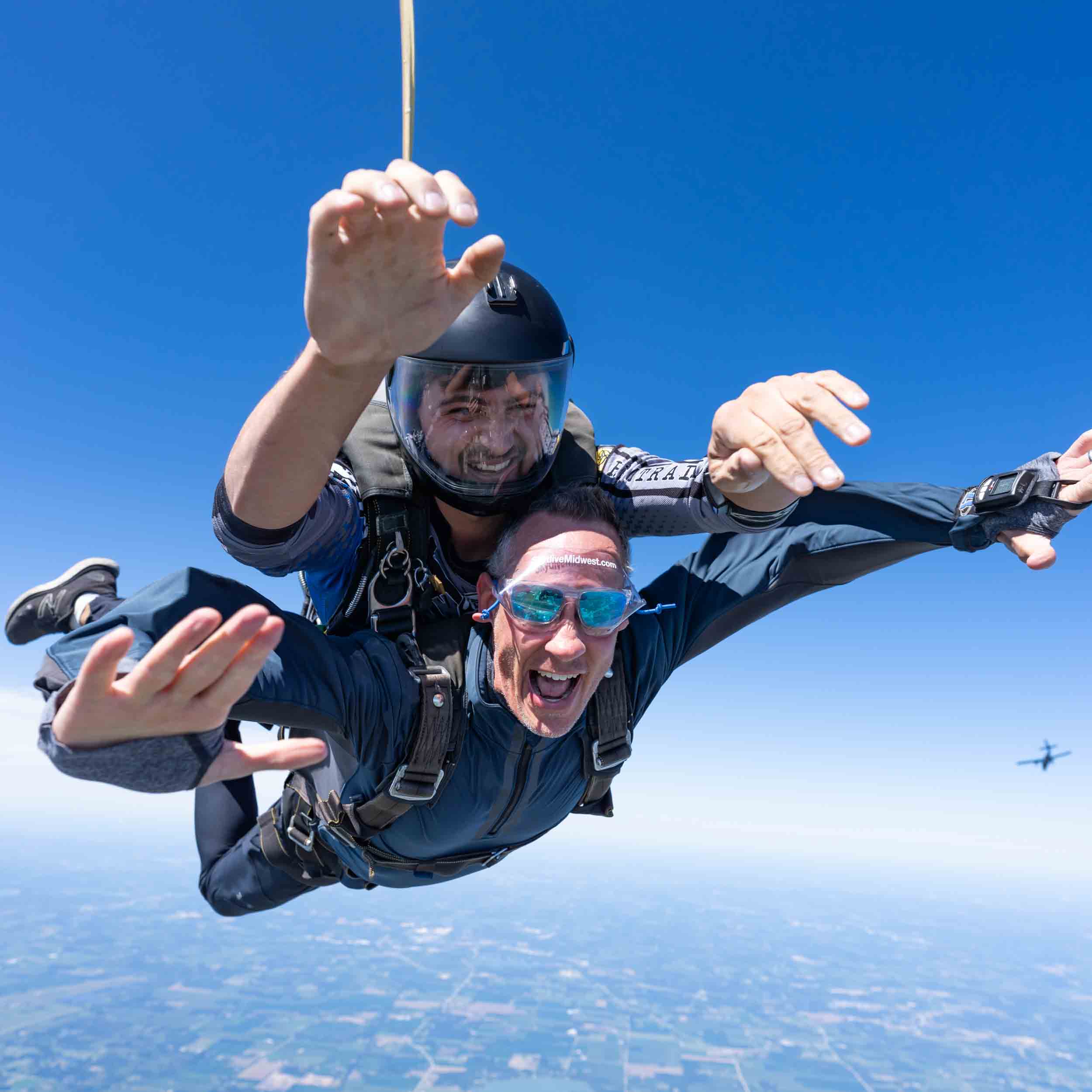
If you're reading this, you're probably thinking about a tandem skydive — and tandem has the lowest fatality rate of any type of skydiving.
Based on USPA data, the industry average is roughly 1 tandem fatality per 500,000 jumps. In 2023, there were zero tandem fatalities across the entire United States.
Why does tandem have a much lower fatality rate than other types of skydiving? A few reasons:
- Your instructor handles everything. They deploy the parachute, steer the canopy, and manage the landing. Your job is to take it all in.
- Tandem instructors are the most experienced people at the dropzone. A tandem rating requires a minimum of 3 years in the sport and 500 jumps. Most of our instructors have thousands of jumps and 10+ years of experience. Several have been jumping longer than some of our students have been alive.
- The leading cause of skydiving fatalities is aggressive canopy piloting — experienced jumpers intentionally pushing the limits of high-performance parachutes. That's not something that happens on a tandem skydive. Tandem canopies are large, stable, and designed for soft landings.
Bottom line: the vast majority of skydiving fatalities involve experienced jumpers making high-risk choices. Not tandem students.
How the Equipment Works
Modern skydiving safety equipment has multiple layers of redundancy built in. Nothing relies on a single point of failure.
Two Parachutes on Every Rig
Every skydiving rig carries a main parachute and a reserve parachute. The reserve is there in case the main has any issue. It's packed by an FAA-Certified Parachute Rigger and inspected every 180 days. At Skydive Midwest, we use SIGMA tandem container systems with TX2 main canopies by Icarus — purpose-built for tandem jumps.
Automatic Activation Devices (AADs)
Every rig carries an Automatic Activation Device — we use Vigil AADs. If a skydiver is still in freefall below a preset altitude — typically around 750 feet — the AAD automatically deploys the reserve parachute. It's a computer that doesn't rely on human decision-making.
Gear Checks Before Every Jump
Instructors inspect their own gear before every jump. Then a second qualified jumper checks it again. Two sets of eyes, every time. Nothing leaves the ground without being verified.

How Skydiving Is Regulated
Skydiving isn't some unregulated thrill ride. Two major organizations oversee it:
The Federal Aviation Administration (FAA)
The FAA regulates all skydiving operations through local Flight Standards District Offices. They regulate everything from aircraft maintenance to pilot certification to how parachutes are packed and inspected. FSDO representatives conduct audits and can show up unannounced. Skydive Midwest maintains a strong working relationship with the Milwaukee FSDO.
The United States Parachute Association (USPA)
USPA sets the Basic Safety Requirements (BSRs) that the overwhelming majority of U.S. dropzones follow. These cover everything from how high you need to be when you deploy a parachute to how instructors get certified. If a dropzone follows USPA standards, they're playing by the book. Membership is voluntary — but operating outside USPA standards is a red flag.
Safety & Training Advisors (S&TA)
USPA requires every member dropzone to have a designated Safety & Training Advisor on-site. The S&TA oversees daily operations, enforces safety standards, and mentors jumpers. Skydive Midwest voluntarily designates more S&TAs than the minimum required — because one set of eyes isn't always enough.
What to Expect at Skydive Midwest
We've been doing this since 2004. Safety isn't a talking point here — it's how we've stayed in business for over 20 years.
- USPA-member dropzone following all Basic Safety Requirements — the same standards behind 2024's record-low fatality rate
- In-house A&P/IA certified aircraft mechanics — our planes are maintained by our own team, on-site, not outsourced
- Multi-engine aircraft carrying up to 23 jumpers per load — more power means more margin on every climb
- Annual instructor retraining — we do this every year even though it's not required
- Annual Safety Day plus mid-season safety seminars
- Expert S&TA and Tandem Instructor Evaluator on-site
- Premium equipment — SIGMA containers, TX2 canopies, Vigil AADs across the board
Every tandem student gets a thorough ground briefing before going up. We walk you through body position, freefall, and — most importantly — how to land. We take the time because it matters.
How to Prepare for Your Jump
Your instructor handles the technical side. But there are a few things you can do to make the experience as smooth and safe as possible:
- Show up rested and sober. No alcohol within 8 hours of your jump. We will turn you away — no exceptions.
- Wear the right clothes. Closed-toe athletic shoes and comfortable clothing that won't flap in 120 mph wind. Skip the boots, sandals, and jewelry. See our full guide on what to wear →
- Listen during your briefing. The training matters. Pay attention to body position and landing instructions.
- Lift your legs for landing. This is the single most important thing you'll do as a tandem student. Get this right, and your landing will feel like stepping off a curb. Lifting your legs lets your instructor handle the touchdown and prevents ankle injuries — the most common skydiving injury.
- Empty your pockets. Phones, keys, loose items — leave them in a locker. We provide lockers for all students.
- Tell us about medical conditions. Heart conditions, back problems, recent surgeries, seizure disorders — if you have concerns, talk to your doctor before booking. We're not medical professionals and we don't give medical advice on whether you should jump.
Is Skydiving Safer Than Driving?
People ask this a lot — and the answer might surprise you.
The National Highway Traffic Safety Administration puts your odds of dying on any single car trip at roughly 1 in 8,300. Your odds on a single skydive? 1 in 434,783. By that measure, a single skydive carries roughly 50 times lower statistical risk than a single car trip.
The dangers of skydiving are real — it's an extreme sport, not a theme park ride. But if you accept the statistical risk of driving a car every day, this might put skydiving in perspective.
Tandem skydiving is specifically designed for first-time jumpers with zero experience. You're harnessed to a certified instructor who handles deployment, steering, and landing. According to USPA data, the tandem fatality rate is approximately 1 in 500,000 jumps, and in 2023, there were zero tandem fatalities nationwide. Like any extreme sport, risk exists — but tandem has the lowest fatality rate of any type of skydiving.